Blog

Signs of High-Quality Upholstery Work

Tight, even stitching with no visible thread ends, fabric pulled smooth with no wrinkles or sagging, aligned patterns across seams, cushions that fit snugly, and a frame that feels solid with no wobble are the clearest signs of high-quality upholstery work. Checking for these when your furniture is delivered helps you catch a rushed or careless job before you’ve fully settled into using the piece.

Most people can spot obvious problems, but quality craftsmanship shows up in small details that are easy to miss at a glance. This guide walks through exactly what to check, including a few areas people commonly overlook.

Stitching precision

Good stitching is tight, even in length, and follows a straight line with no visible thread ends or puckering in the fabric around the seam. Uneven stitch length or loose threads are one of the fastest ways to spot rushed work.

Run your hand gently along a seam and give it a light tug. Quality stitching holds firm with no gaps opening up, while poor stitching may show slight separation or loose threads pulling through. Corners and curved seams, like around armrests, are worth checking closely, since these are the hardest areas to stitch cleanly and where quality differences show up most clearly.

Fabric tension and smoothness

Fabric should sit smooth and taut across the frame with no visible wrinkles, sagging, or loose pockets. Fabric that’s been pulled and secured properly holds its shape evenly across the entire surface, while poorly tensioned fabric develops soft folds or bunching, especially around curves and corners.

Wrinkles are most noticeable on flat surfaces like the back cushion area or seat deck, where uneven tension has the most room to show. If you notice loose fabric in these areas shortly after delivery, it’s a sign the fabric wasn’t pulled tight enough during installation, and it typically won’t improve on its own over time.

Pattern and grain alignment

On patterned fabric, the design should line up continuously across seams and cushions, rather than shifting or breaking awkwardly where two pieces of fabric meet. This kind of alignment takes deliberate planning during cutting and is one of the clearest markers of careful craftsmanship.

Even on solid fabric, checking the fabric’s grain, the direction the weave runs, matters. Fabric applied with inconsistent grain direction can catch light differently across the piece, creating a subtle shading mismatch that’s easy to notice once you see it, even if you can’t immediately explain why something looks slightly off.

Piping and seam alignment

Piping, the trim cord often used along seams and cushion edges, should run in a straight, continuous line without twisting, puckering, or visible gaps where it meets at corners. Crooked or uneven piping is a common sign of rushed finishing work.

Seams themselves should meet cleanly at corners and edges, without one side sitting higher or lower than the other. This kind of alignment issue is often easiest to spot from a slight distance, stepping back a few feet from the piece can reveal misalignment that’s harder to notice up close.

Cushion fit and cover closures

Cushions should fit snugly inside their covers, without excess loose fabric or covers so tight they distort the cushion’s shape. Zippers and other closures should operate smoothly without snagging, and shouldn’t be visible from the front of the cushion unless designed that way intentionally.

Removing and replacing a cushion cover, if possible, is a good practical test, since it should go on smoothly without requiring excessive force. A cover that’s difficult to zip or noticeably tight is often a sign of imprecise cutting or foam sizing during the upholstery process.

Frame solidity and finish check

A quality piece should feel completely solid with no wobble, creaking, or shifting when you press down on different areas or gently rock it. Any looseness suggests the frame wasn’t properly repaired or reinforced before the new upholstery went on.

Exposed wood or metal, like legs or trim, should have a clean, even finish with no visible tool marks, rough edges, or mismatched staining. These visible frame elements are often an easy area to check quickly and tend to reflect the same level of care applied throughout the rest of the piece.

Attention to hidden areas

Checking the underside and back of a piece often reveals more about craftsmanship than the visible surface, since a rushed job tends to cut corners specifically in areas that aren’t immediately seen. Look at how the fabric is finished and secured underneath, and whether the back of the piece receives the same care as the front.

A well-finished underside typically shows a clean dust cover, evenly stapled or tacked fabric edges, and no loose or fraying material. If the underside looks noticeably rougher than the visible surfaces, it’s worth asking the provider about their finishing standards for areas that aren’t on display.

Color and fabric consistency across the piece

Fabric color and texture should look consistent across the entire piece, including cushions, armrests, and back panels, with no visible variation between sections that were meant to match. Slight fabric roll variation can sometimes cause subtle shading differences, but a skilled upholsterer accounts for this during cutting.

This matters especially on multi-cushion sofas, where cushions cut from different points on a fabric roll can show a visible shade difference if not carefully matched. Comparing cushions side by side in natural light is the easiest way to catch this kind of inconsistency.

Can you tell quality just by looking, or do you need to test it too?

The short answer

Both. Visual inspection catches most craftsmanship issues, but a few quality checks, tugging seams, testing zippers, pressing on the frame, require physically interacting with the piece rather than just looking at it.

What you can catch visually

Stitching evenness, fabric smoothness, pattern alignment, and color consistency are all visible at a glance or with close inspection, without needing to touch or test anything.

What you need to physically test

Seam strength, zipper function, and frame solidity all require interacting with the piece directly, gently tugging seams, opening and closing zippers, and pressing or rocking the frame to check for looseness.

The verdict

Do both. A quick visual scan followed by a few minutes of hands-on testing gives you a much more complete picture of quality than either approach alone, and takes only a few extra minutes when the piece is delivered.

Frequently Asked Questions

What are the signs of high-quality upholstery work?

Tight, even stitching, smooth fabric with no wrinkles or sagging, aligned patterns across seams, snug-fitting cushions, a solid frame with no wobble, and consistent color and finish throughout are the clearest signs of quality upholstery craftsmanship.

How can I tell if upholstery stitching is good quality?

Good stitching is tight, even in length, and follows a straight line with no visible thread ends or puckering in the fabric around the seam. Gently tugging on a seam should show no gaps or loose threads.

Should you inspect the underside of upholstered furniture?

Yes. Checking the underside and back of a piece often reveals more about craftsmanship than the visible surface, since a rushed or lower-quality job tends to cut corners in areas that aren’t immediately seen.

Expect Quality at Every Stage

From frame repair to final stitching, our team applies the same standard of craftsmanship to every visible and hidden detail of your furniture. If you’re still deciding who to hire or what to ask before starting a project, our guides on what to look for in a local upholstery service and questions to ask before repairing a sofa cover those earlier steps. Visit our sofa upholstery services page to see our full range, or reach out for a free assessment and quote.

What Furniture Is Worth Restoring?

Furniture is worth restoring when the frame or core structure is solid, the materials are higher quality than what you’d find in comparable new furniture at a similar price point, or the piece holds sentimental, antique, or design value a replacement can’t replicate. The frame is the deciding factor in almost every case, since fabric, finish, and hardware can all be redone if the underlying structure is sound.

Not every worn piece deserves the investment, and not every old piece is automatically worth saving. This guide walks through the categories of furniture that consistently make sense to restore, and the situations where replacement is the more practical call.

Solid construction and material quality

Furniture built from solid wood, genuine joinery, and quality frame materials is almost always worth restoring, since these construction methods are increasingly rare in mass-produced furniture sold today. A frame like this can typically be restored multiple times over decades.

This is one of the most common reasons restoration makes financial sense even beyond sentimental value. A dining table or bed frame built decades ago, before flat-pack and particleboard construction became standard, often used materials and joinery techniques that would cost significantly more to replicate in a new piece today. Restoring furniture like this isn’t just preserving the past, it’s often getting access to a build quality that’s hard to buy new at any reasonable price.

Antique and vintage furniture

Antique and vintage furniture is generally worth restoring, both for the craftsmanship it represents and for the value it can hold or increase over time with proper care. Antique frames were typically built using joinery designed to be repaired and restored repeatedly, which makes them well suited to this kind of work.

There’s a nuance worth knowing here: restoring too much of a genuine antique can actually reduce its collector value. As a general guideline, restoring up to around 30 percent of an antique piece is considered acceptable without significantly affecting its worth, while more extensive restoration can start to be seen as reducing what’s original about the piece. If a piece has real collector or appraisal value, it’s worth getting that assessed before deciding how much restoration work to do.

Sentimental and heirloom pieces

Furniture with strong sentimental value, a piece passed down through family, tied to a specific memory or milestone, is almost always worth restoring regardless of how the cost compares to buying new. The value being preserved isn’t purely financial.

For these pieces, the usual cost-benefit calculation matters less than it does for a typical furniture decision. A frame that’s structurally sound can almost always be restored to serve its original purpose again, and for a piece with real personal meaning, that’s often reason enough on its own.

Furniture with a good frame but tired fabric or finish

A piece where the frame is completely solid but the fabric is worn, the wood finish is scratched, or the upholstery is outdated is one of the clearest and most cost-effective restoration cases. This describes a large share of furniture that people consider replacing unnecessarily.

In these situations, the cost of restoration, reupholstery, refinishing, or both, is almost always lower than replacing the entire piece, since you’re only paying for new materials and labor rather than an entirely new frame. If you’re specifically weighing this decision for an upholstered piece, our guide on whether reupholstery is worth it breaks down the cost comparison in detail.

Furniture worth restoring for design reasons

Rare, discontinued, or custom-made pieces are often worth restoring simply because an equivalent replacement isn’t readily available, regardless of cost comparison. If you love the shape, size, or design of a piece you can’t easily find again, restoration is often the only realistic path to keeping it.

This applies to outdoor furniture as much as indoor pieces. High-end teak, aluminum, or wrought iron patio sets, in particular, are frequently worth restoring rather than replacing, since quality outdoor materials are specifically built to be refinished and repaired repeatedly over the years.

When furniture is not worth restoring

Furniture generally isn’t worth restoring when the frame itself is cracked, rotted, or built from particleboard that can no longer hold fasteners securely, or when the piece was low quality to begin with and has no sentimental or design value attached to it.

In these cases, the cost of restoration starts to approach or exceed the cost of an equivalent replacement, which removes the main financial argument for restoring rather than replacing. A frame that wobbles even after every joint has been tightened, or shows soft, spongy wood, is usually signaling damage beyond what restoration alone can fix.

How much of a piece can be restored before it loses value?

For antiques specifically, restoring roughly 30 percent or less of the piece is generally considered acceptable without significantly affecting collector value. Beyond that threshold, extensive restoration can start to be viewed as compromising the piece’s originality.

This guideline matters less for non-antique furniture, where the goal is functional and aesthetic restoration rather than preserving collectible value. For a typical family piece with sentimental rather than monetary value, restoring as much as needed to bring it back to full use is usually the right call, without needing to worry about this threshold.

Is furniture age itself a reason to restore or not restore?

The short answer

No, not on its own. Age matters far less than construction quality and frame condition. Some older furniture is an excellent restoration candidate, while other older pieces were never well built to begin with.

When age works in a piece’s favor

Furniture built before mass-produced, flat-pack construction became common often used solid wood and real joinery, which tends to make older pieces stronger restoration candidates than their age alone would suggest.

When age works against a piece

Older furniture that was cheaply made to begin with, or that’s suffered water damage, pest damage, or prolonged neglect, doesn’t become a better restoration candidate simply because of its age.

The verdict

Judge the frame and materials, not the age on its own. A well-built piece from any era is worth restoring if the structure holds up, while age alone is never a reliable shortcut for that decision.

Frequently Asked Questions

What furniture is worth restoring?

Furniture is worth restoring when the frame or core structure is solid, the materials are higher quality than comparable new furniture at a similar price point, or the piece holds sentimental, antique, or design value that a replacement can’t replicate.

Is old furniture usually better quality than new furniture?

Often, yes. Furniture made before mass-produced flat-pack construction became common frequently used solid wood, real joinery, and higher-grade materials that are harder to find in budget and mid-range new furniture today.

How much of an antique can be restored without losing its value?

As a general guideline, restoring up to about 30 percent of an antique piece is considered acceptable without significantly affecting its value. Restoring beyond that threshold can start to reduce what collectors and appraisers consider original.

Not Sure If Your Piece Is Worth Restoring?

Our team can assess your furniture’s frame and materials and give you an honest recommendation, whether that’s restoration, reupholstery, or letting you know replacement makes more sense. This applies to outdoor furniture as well, where our guide on outdoor furniture repair services covers restoration for teak, aluminum, and wrought iron pieces specifically. Visit our sofa repair and upholstery services page to see our full range, or reach out for a free assessment and quote.

Is It Worth Reupholstering Dining Chairs?

Yes, in most cases, especially for a full set. Reupholstering dining chairs typically costs 40 to 60 percent less than buying a comparable new set, as long as the chair frames are solid wood and structurally sound. It’s not worth it when the frames are cheap particleboard, already loose beyond simple tightening, or the chairs were low quality to begin with.

Dining chairs take more daily wear than almost any other seating in the home, spills, sliding in and out, constant weight shifting, which makes this a common question. This guide breaks down the real cost comparison and exactly when reupholstering makes sense.

How much does it cost to reupholster dining chairs vs buying new?

Reupholstering a dining chair typically costs anywhere from AED 80 for a simple seat fabric change up to AED 250 or more per chair for a complete refurbishment including frame repair and new foam. A comparable new dining chair of similar quality usually costs AED 400 to AED 1,200 or more.

For a full set of six chairs, this difference adds up quickly. Reupholstering a full set typically runs somewhere between AED 800 and AED 1,500, compared to AED 2,500 to AED 8,000 or more for a new set of similar quality. This gap is usually widest for higher-quality chairs, since replacing a well-built set costs considerably more than restoring one. For exact pricing on your specific chairs, our dining chair upholstery service page covers current rates and what’s included at each price tier.

What makes a dining chair frame worth reupholstering?

A dining chair frame is worth reupholstering when it’s built from solid wood, sits stable with no significant wobble, and has joints that hold firm or only need minor tightening. Dining chairs face more repeated stress at the joints than most furniture, since sliding a chair in and out and shifting weight while seated both put ongoing pressure on the leg and seat connections.

This is why joint condition matters even more here than on a sofa or armchair. A chair that wobbles slightly can often be reinforced during reupholstery, but a chair with joints that have already failed and been re-glued multiple times is a less reliable candidate, since the wood around those joints has likely weakened with each repair.

Do all chairs in a set need to be reupholstered together?

Not necessarily, but reupholstering the full set together usually costs less per chair than doing them one at a time, and ensures the fabric matches consistently across every seat. Providers commonly offer a discount for sets of four or more.

If only one or two chairs in a set show damage, it’s still worth checking whether reupholstering just those chairs will visibly stand out against the others, especially if the original fabric has faded over time. In that case, doing the full set at once, even if not all chairs strictly need it, often produces a more cohesive result.

Does fabric choice affect whether it’s worth it?

Yes. Choosing a durable, stain-resistant fabric extends how long the reupholstery job lasts, which directly affects the value you get from the investment. A cheap, non-resistant fabric on a daily-use dining chair may need redoing again within just a couple of years.

Since dining chairs face more food and liquid exposure than almost any other upholstered furniture, fabric choice matters more here than it does on many other pieces. Our guide to stain-resistant dining chair fabric covers which materials hold up best under regular use.

Is it worth reupholstering mismatched or inherited dining chairs?

Often, yes, particularly if the chairs are solid wood, since reupholstering with matching fabric can unify a mismatched or inherited set into a cohesive look without needing to replace any of the frames. This is one of the more satisfying reupholstery projects, since the transformation is significant relative to the cost.

Inherited chairs, in particular, are frequently built from higher-quality wood than what’s commonly sold new today, which makes them strong reupholstery candidates even when their current fabric or finish looks dated.

When is it not worth reupholstering a dining chair?

Reupholstering isn’t worth it when the frame is built from particleboard or thin, low-grade wood that’s already showing cracks or won’t reliably hold fasteners. It also doesn’t make sense for very low-cost, mass-produced chairs where a new chair costs about the same as the reupholstery job itself.

In these cases, the math simply doesn’t work in reupholstery’s favor. If a new equivalent chair costs close to what a quality reupholstery job would cost, there’s little financial reason to restore the old one unless it carries sentimental value.

Watch out for unusually cheap quotes

A quote significantly below the typical range for dining chair reupholstery is often a sign of thin, low-grade foam, machine tufting instead of hand finishing, or fabric that won’t hold up well under daily use. The cheapest quote isn’t always the best value once you factor in how long the work will actually last.

It’s worth asking directly what foam density and fabric grade are included in a low quote before assuming it’s simply a good deal, since these details affect how many years you’ll get out of the finished chairs.

Is it worth reupholstering just the seat, or the whole chair?

The short answer

It depends on where the wear is. If only the seat cushion shows damage and the back and frame are in good shape, seat-only reupholstery is a reasonable, lower-cost option. If wear or fading is visible across the whole chair, full reupholstery gives a more consistent result.

When seat-only makes sense

Chairs with a solid wood back and frame, where only the seat cushion has worn fabric or flattened foam, are good candidates for a lower-cost seat-only refresh.

When full reupholstery makes more sense

If the back cushion also shows wear, or if seat-only fabric wouldn’t match the surrounding upholstery well, doing the full chair avoids an inconsistent, visibly patched-together look.

The verdict

Match the scope of the job to the actual wear pattern on the chair. Seat-only reupholstery is a smart way to save on chairs with isolated wear, while full reupholstery is worth the extra cost when wear or fading is spread across the whole piece.


Frequently Asked Questions

Is it worth reupholstering dining chairs?

Yes, in most cases, especially for a full set. Reupholstering dining chairs typically costs 40 to 60 percent less than buying a comparable new set, as long as the frames are solid wood and structurally sound.

Do all chairs in a dining set need to be reupholstered at once?

Not necessarily, but reupholstering the full set together usually costs less per chair than doing them separately, and ensures consistent fabric matching across the whole set.

Is it worth reupholstering cheap or mismatched dining chairs?

It depends on the frame. Solid wood chairs, even inexpensive or mismatched ones, are usually worth reupholstering. Chairs built from particleboard or thin, low-grade wood often aren’t, since the frame won’t hold up long-term regardless of the new fabric.


Get a Free Quote for Your Dining Chairs

Send us a few photos of your chairs and we’ll give you an honest answer on whether they’re worth reupholstering, along with a clear quote, usually within an hour. If you’re deciding on a different piece of furniture, our general guide on whether reupholstery is worth it covers the broader cost comparison. Visit our dining chair upholstery services page to get started, or reach out for a free quote.

Why Choose Leather Upholstery for Your Dubai Home

Leather resists dust, wipes clean instantly, and can last 15 to 25 years with proper care, which makes it a strong choice for Dubai homes, as long as the room has consistent, stable air conditioning. The real decision isn’t just fabric versus leather, it’s which leather grade actually fits your budget and how your specific room is cooled.

This guide focuses on the two things that actually determine whether leather is the right call: which grade you’re paying for, and whether your room’s conditions suit it. For the broader material comparison against fabric, our leather vs fabric sofa guide covers durability, comfort, and cost side by side in more depth.

What leather grade should you actually choose?

Leather sold for upholstery falls into four main grades, full-grain, top-grain, corrected-grain, and bonded or faux leather, and the grade matters more than almost any other factor in how the sofa performs and ages over time.

Full-grain leather

Full-grain uses the entire natural hide with none of the surface sanded away, which means it shows the leather’s natural markings and develops a rich patina as it ages. It’s the most durable and highest-cost option, typically lasting 20 to 25 years or more with proper conditioning.

Top-grain leather

Top-grain has the very top layer lightly sanded and treated, giving it a more uniform, consistent appearance while still using genuine leather. It costs less than full-grain and holds up well, typically lasting 15 to 20 years, making it a strong middle-ground choice for most households.

Corrected-grain leather

Corrected-grain leather has more of the surface sanded and an artificial texture embossed on top, which lowers cost further but also reduces breathability and long-term durability compared to full or top-grain. It’s a reasonable option for lighter-use furniture on a tighter budget.

Bonded and faux leather

Bonded leather uses scraps of leather fiber bonded together with a polyurethane coating, while faux leather is entirely synthetic. Both cost significantly less upfront but typically only last 3 to 7 years before peeling or cracking, especially under Dubai’s heat and sun exposure.

The grade you choose should match how the piece will actually be used. A daily-use family sofa justifies the investment in top-grain or full-grain, while a rarely used accent chair may not need to carry that same cost.

Does leather suit Dubai’s climate specifically?

Leather performs well in Dubai only when the room’s air conditioning runs consistently. Temperature cycling, switching AC on and off throughout the day, is one of the leading causes of leather cracking here, more than heat or humidity on their own.

This is worth checking honestly before committing to leather. A room where AC runs consistently between 20 and 24°C year-round gives leather a stable environment to hold up in. A room where the AC gets switched off during the day, common in guest rooms or homes where residents are away for long stretches, puts leather at a real disadvantage compared to fabric, which doesn’t have the same sensitivity to these swings.

Is leather a good investment compared to fabric?

Leather generally offers better long-term value in rooms with stable climate control, since its longer lifespan can offset the higher upfront cost over time. In less climate-stable spaces, that advantage narrows or disappears, since leather that cracks prematurely no longer delivers on its durability promise.

Think of the investment case as conditional rather than universal. Full-grain leather in a consistently cooled living room genuinely outlasts most fabric options and can justify its higher price. The same leather in an inconsistently cooled space may need reupholstery sooner than a well-chosen fabric would have, which flips the value equation entirely.

Which rooms and households suit leather best?

Leather suits formal living rooms, home offices, and daily-use family rooms with consistent AC particularly well, since it holds up to regular use and wipes clean quickly. It’s also a strong fit for households that prioritize low-maintenance cleaning over the softer feel of fabric.

Households with young children who eat on the sofa often, or homes with pets prone to scratching, tend to benefit from leather’s wipe-clean surface and scratch resistance more than a typical formal setting would. If personalization matters to you as much as performance, our guide on custom leather upholstery covers color, stitching, and finish options in more detail.

What to check before committing to leather

Before choosing leather, check your room’s AC consistency, how much direct sun exposure the piece will get, and your realistic budget for the grade that matches your household’s usage. These three checks catch most of the situations where leather underperforms expectations.

Direct sun exposure specifically can dry out even well-maintained leather faster than expected, so a piece positioned near an unshaded window may need more frequent conditioning regardless of grade. If in doubt, ask for a leather sample to test near your specific window or AC vent before committing to a full order.

Is higher-grade leather always worth the extra cost?

The short answer

No. Higher-grade leather is worth it for daily-use furniture in climate-stable rooms, but a lower grade can be perfectly reasonable for occasional-use pieces or tighter budgets.

When is a higher grade worth it

Full-grain or top-grain leather pays off on daily-use sofas in consistently cooled rooms, where the extended lifespan offsets the higher upfront cost within a few years.

When a lower grade is fine

Corrected-grain or even quality faux leather can be a reasonable choice for accent chairs, guest rooms, or budget-conscious projects where the piece sees lighter use.

The verdict

Match the grade to the piece’s actual role in your home rather than defaulting to the highest grade available. A well-matched mid-grade leather often outperforms an expensive full-grain hide placed in the wrong conditions.

Frequently Asked Questions

Why is leather a good choice for a Dubai home?

Leather resists dust, wipes clean instantly, and can last 15 to 25 years with proper care, making it well suited to Dubai homes as long as the room has consistent, stable air conditioning to prevent drying and cracking.

What leather grade is best for a sofa?

Full-grain leather offers the highest quality and develops character over time, top-grain offers strong durability with more uniform appearance at a lower cost, and corrected-grain or bonded leather suit tighter budgets but wear faster.

Is leather always worth the higher cost compared to fabric?

Not always. Leather is worth the investment in rooms with stable air conditioning and for households prioritizing easy maintenance, but fabric can be the more practical and cost-effective choice in less climate-controlled spaces.

Find the Right Leather for Your Home

Our team can bring leather samples in every grade to your home, check how your specific room’s conditions affect the decision, and help you choose the right leather for your budget and lifestyle. Visit our leather sofa upholstery services page to see our full range, or reach out for a free consultation and quote.

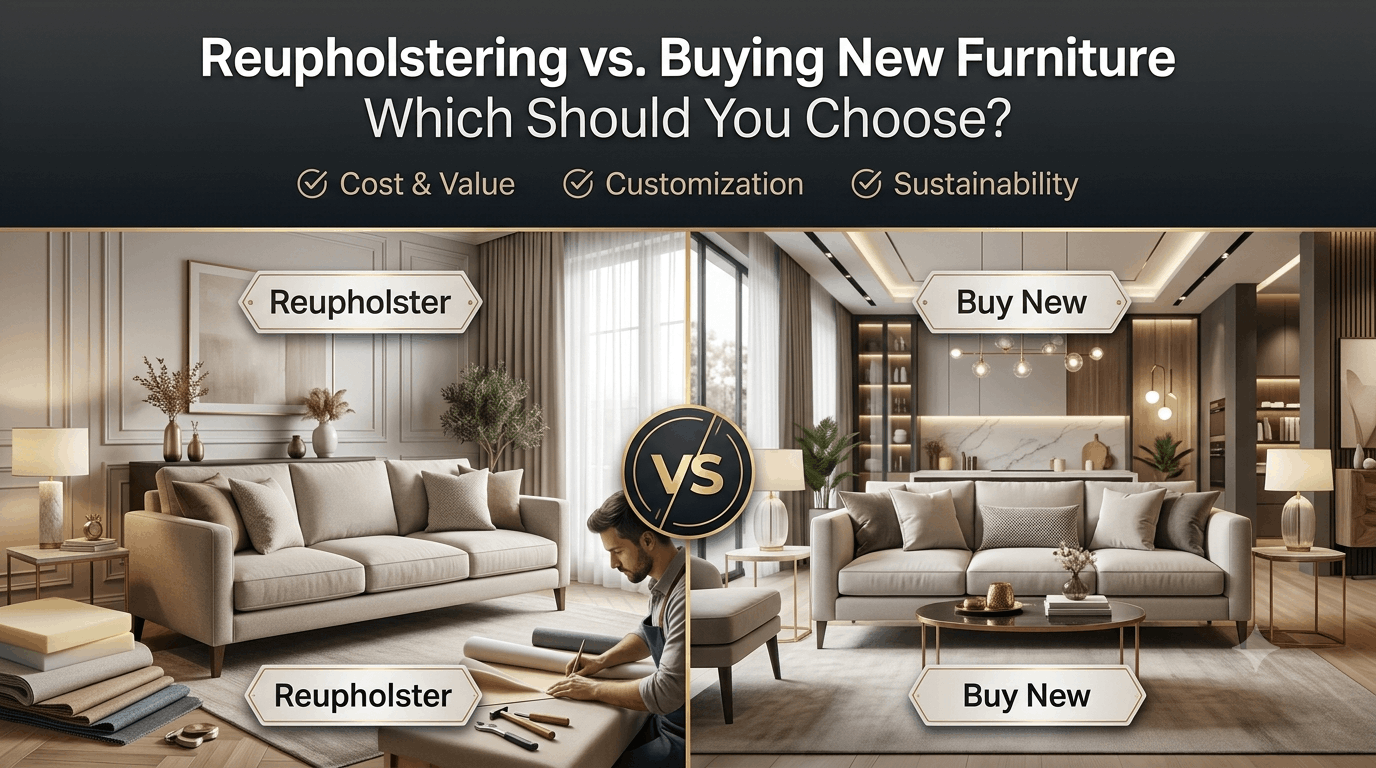
Reupholstering vs. Buying New Furniture: Which Should You Choose?

Reupholstering makes sense when you already like the shape, size, and frame quality of your furniture, and just want updated fabric and comfort. Buying new makes more sense when you want a different size or style entirely, or when a longer manufacturer warranty matters more than customization.

Cost is usually the first factor people think about, and we’ve covered that comparison in detail in our guide on whether reupholstery is worth it. This guide looks at the other factors that matter just as much: customization, warranty, fit, timeline, and long-term value.

Customization: what can you actually change?

Reupholstering gives you full control over fabric, color, texture, and finishing details like piping or tufting, but keeps the existing frame shape and size. Buying new gives you access to entirely new shapes, modular configurations, and current design trends that reupholstery can’t change.

If you love your sofa’s proportions and just want a different look, reupholstery covers that completely. If you want a different silhouette altogether, a sectional instead of a standard sofa, for example, that requires a new frame, which only buying new can provide.

Warranty: how coverage differs

New furniture typically comes with an 8 to 10 year manufacturer warranty covering frame and structural defects. Reupholstery work usually carries a shorter workmanship warranty, often 1 to 2 years, covering the materials and labor of the specific job performed.

This gap exists because a reupholstery warranty only covers the new work done, not the age or prior condition of the frame itself. A frame that’s already 15 years old doesn’t come with the same long-term assurance a brand new frame does, even after quality reupholstery work.

Fit and sizing: does the piece already work in your space?

If your current furniture already fits your room’s layout and proportions well, reupholstering keeps that fit intact while refreshing everything else. Buying new introduces sizing risk, since a piece that looks right in a showroom or online listing doesn’t always fit the same way in your actual space.

This matters more in apartments and villas with unusual layouts or built-in space constraints, where finding a new piece that fits exactly right can take considerably more searching than expected. Reupholstering sidesteps that problem entirely, since the dimensions never change.

Timeline: how long does each option take?

Reupholstering a single piece typically takes three to seven working days from pickup to delivery. Buying new furniture can take longer overall once you factor in shopping, comparing options, and delivery lead times, especially for custom or made-to-order pieces.

In-stock new furniture can sometimes arrive faster than a reupholstery job, particularly for simple, mass-produced pieces. Custom or imported new furniture, on the other hand, often takes weeks or months to arrive, which can make reupholstering the faster option overall.

Style and design trends: new vs restored

Buying new gives you direct access to current design trends, modern silhouettes, and manufacturer collections that didn’t exist when your current piece was made. Reupholstering lets you update the look through fabric and color, but the underlying shape stays the same as your original piece.

For most households, updating fabric alone is enough to feel like a genuine refresh. For those chasing a specific new silhouette or structural trend, like a low-profile modern frame replacing a traditional one, buying new is the only way to get there.

Environmental impact

Reupholstering is generally the more sustainable option, since it reuses an existing frame rather than requiring new raw materials, manufacturing, and shipping. Buying new furniture carries a larger environmental footprint from production through delivery, even when the new piece is well made.

Furniture disposal also contributes directly to landfill waste, and reupholstering avoids that outcome entirely by extending what you already own rather than discarding it. For households weighing sustainability alongside style, this factor often tips the decision toward reupholstering.

Resale and long-term value

Well-built furniture with a solid frame tends to hold or even increase in value after quality reupholstery, particularly for antique or imported hardwood pieces. Mass-produced new furniture typically depreciates quickly, similar to how a new car loses value the moment it leaves the showroom.

This is part of why older, solid-frame furniture is often a better long-term investment through reupholstery than through replacement. The frame itself, not the fabric, is usually where the real value sits.

Is it always better to reupholster than buy new?

The short answer

No. Reupholstering wins on cost, sustainability, and preserving a good fit, but buying new wins when you want a different size, shape, current design trends, or a longer manufacturer warranty.

When buying new makes more sense

Buying new is the better choice when you want a different furniture shape or size, need a longer structural warranty, or your current piece has a damaged frame that reupholstery can’t fix.

When reupholstering makes more sense

Reupholstering is the better choice when your current piece has a solid frame, fits your space well, and you mainly want updated fabric, comfort, or color rather than a different shape entirely.

The verdict

Neither option is universally better. The right call depends on whether you’re happy with your furniture’s shape and fit, or whether you’re looking for something genuinely different. For more on what the process involves once you decide, our guide on what furniture reupholstery includes walks through each step, and our piece on upholstery vs reupholstery clears up the related terminology if you’re comparing quotes from different providers.

Frequently Asked Questions

Should I reupholster my furniture or buy new?

Reupholster if your current piece has a solid frame that fits your space well and you’re happy with its shape and size. Buy new if you want a different size, shape, or the newer manufacturer warranties that reupholstery can’t offer.

Does new furniture come with a better warranty than reupholstered furniture?

Usually, yes. New furniture often comes with 8 to 10 year manufacturer warranties, while reupholstery work typically carries a 1 to 2 year workmanship warranty on the materials and labor performed.

Is reupholstering more sustainable than buying new furniture?

Yes. Reupholstering reuses an existing frame, which reduces demand for new raw materials and keeps usable furniture out of landfills, making it a more sustainable choice than buying new in most cases.

Get Help Deciding

Not sure which option fits your situation? Our team can assess your furniture’s frame, talk through fabric and timeline, and give you an honest recommendation, even if that means telling you buying new is the better call. Visit our sofa upholstery services page to see our full range of options, or reach out for a free assessment and quote.

Is Reupholstery Worth It? Cost vs. New Furniture

Yes, reupholstery is worth it in most cases, as long as the furniture’s frame is still solid. It typically costs 40 to 60 percent less than buying an equivalent new piece and can add another 10 to 15 years of use to well-built furniture. The exceptions are narrow: a cracked or rotted frame, or a piece that was low quality from the start.

That said, “worth it” depends on more than just cost. This guide walks through the real factors, price comparisons, sentimental value, furniture age, and environmental impact, so you can make the call with confidence rather than guessing.

When is reupholstery worth it?

Reupholstery is worth it when the frame is structurally sound, the piece fits your space well, and replacing it with something equivalent would cost more than restoring it. These three conditions cover the majority of household furniture.

A solid wood or metal frame is the biggest factor here. Everything else, foam, springs, fabric, can be replaced or repaired without much difficulty. If you already love the shape, size, and comfort level of a piece and only the look or feel has worn out, reupholstery almost always makes financial sense over buying new. For a full breakdown of what the process actually involves, our guide on what furniture reupholstery includes covers the frame repair, padding, and fabric steps in detail.

When is reupholstery not worth it?

Reupholstery isn’t worth it when the frame is cracked, rotted, or built from particleboard that can no longer hold screws or staples securely. It also makes less sense for low-quality furniture that wasn’t well built in the first place, since the frame won’t justify the investment.

A frame that wobbles even after every joint has been tightened, or one with soft, spongy wood, usually signals damage that goes beyond what reupholstery can fix. In these cases, the cost of reupholstery starts approaching the cost of a new piece anyway, which removes the main financial advantage.

Reupholstery cost vs buying new

Furniture Type Typical Reupholstery Cost (AED) Typical New Purchase Cost (AED)
Dining chair 150 – 400 400 – 1,200
Accent or armchair 600 – 1,500 1,500 – 4,000
Two or three-seater sofa 1,800 – 4,500 4,000 – 12,000+
Large sectional 4,000 – 9,000 10,000 – 25,000+

Across every furniture type, reupholstery lands well below the cost of a comparable new piece, particularly for mid-range and higher-quality furniture. The savings shrink for very cheap, mass-produced furniture, since a new budget piece can sometimes cost close to what reupholstery would.

Does the age of furniture affect whether reupholstery is worth it?

Yes, but not in the way most people expect. Older furniture, especially pieces built before the 2000s, is often a better reupholstery candidate than newer furniture, since older frames were more commonly built from solid wood rather than particleboard.

Furniture age alone doesn’t determine value. What matters is construction quality at the time it was made. A 20-year-old solid oak frame is usually a stronger reupholstery candidate than a 3-year-old sofa built with a stapled particleboard frame, even though the newer piece seems like it should have more life left.

Is reupholstery worth it for sentimental or antique furniture?

Almost always, yes. Sentimental and antique furniture often carries value that a replacement simply can’t replicate, and antique frames are typically built using joinery methods designed to be repaired and restored rather than replaced.

For pieces passed down through family or tied to a specific memory, the cost comparison against buying new becomes less relevant. The value being preserved isn’t just the furniture itself, it’s the piece’s history, which makes reupholstery worth it even in cases where the math alone might not fully justify it.

Is reupholstery worth it environmentally?

Yes. Reupholstering furniture keeps usable frames out of landfills and reduces the demand for new raw materials, making it a more sustainable choice than replacing furniture that still has structural life left.

Furniture manufacturing has a real environmental footprint, from timber and foam production to shipping and packaging. Extending a frame’s life through reupholstery avoids that footprint entirely for another decade or more, which is a meaningful factor for households that weigh sustainability alongside cost.

How to decide: a quick checklist

Answer these questions to see whether your piece is a strong reupholstery candidate:

  • Is the frame solid wood or metal, with no major cracks or soft, rotted spots?
  • Do you like the shape, size, and overall structure of the piece as it is?
  • Would an equivalent new piece cost more than reupholstering this one?
  • Does the piece have sentimental value, or is it a well-built antique?
  • Is the damage limited to fabric, padding, or springs, rather than the frame itself?

If you answered yes to most of these, reupholstery is very likely worth it. If you answered no to the first question specifically, frame condition, replacement is usually the more practical choice regardless of the others.

Is reupholstery worth it if the furniture already has structural damage?

The short answer

It depends on where the damage is. Minor structural issues, like a loose joint or a cracked rail, are usually still worth repairing as part of the reupholstery process. Major damage, like a fully rotted frame, usually isn’t.

When it’s still worth it

Loose joints, minor cracks, worn webbing, and sagging springs are all repairable during a reupholstery job and don’t change the overall value equation much. These are common issues, not dealbreakers.

When it’s not worth it

A frame that’s cracked through its full thickness, rotted from moisture damage, or made from particleboard that’s already failed once is a sign that further investment won’t hold up long-term.

The verdict

Structural damage doesn’t automatically rule out reupholstery, it depends on severity. A professional assessment before committing to a project is the safest way to know which category your furniture falls into. Our team at Repair Sofa Dubai offers a free in-home evaluation for exactly this reason.

Frequently Asked Questions

Is reupholstery worth it?

Yes, in most cases, as long as the frame is solid. Reupholstery typically costs 40 to 60 percent less than buying an equivalent new piece and can add another 10 to 15 years to a well-built piece of furniture.

Is it worth reupholstering an old sofa?

It’s worth reupholstering an old sofa if the frame is solid wood or metal with no major cracks or rot. Older sofas with solid frames are often better candidates than newer, mass-produced pieces built with particleboard.

When is reupholstery not worth it?

Reupholstery isn’t worth it when the frame is cracked, rotted, or made from particleboard that can’t hold fasteners, or when the piece was low quality to begin with and has no sentimental or resale value.

Get a Free Assessment Before You Decide

Not sure which category your furniture falls into? Our team can usually tell within minutes of seeing it. We check the frame, walk you through fabric and cost options suited to your piece, and give you an honest recommendation, not just a sales pitch. Our professional upholstery services cover everything from minor repairs to full reupholstery, and if replacement turns out to be the better call, we’ll tell you that too, as covered in our piece on repairing vs replacing furniture. Reach out for a free quote.


What Is Furniture Reupholstery? Process & Costs Explained

Furniture reupholstery is the process of stripping a piece of furniture down to its frame and rebuilding it with new padding, springs or webbing where needed, and fresh fabric or leather. It goes far beyond covering the old fabric with a new one. A proper reupholstery job repairs what’s underneath, not just what you see on top.

This is what separates reupholstery from simply throwing a new cover over worn furniture. It restores comfort and structure, not just appearance. For a well-built frame, it’s often the difference between one more year of use and another fifteen.

How does reupholstery differ from recovering?

Recovering means removing only the outer fabric and replacing it with something new, without touching the padding, springs, or frame underneath. It’s faster and cheaper, but it doesn’t fix comfort issues or structural wear.

Reupholstery goes deeper. The upholsterer strips the piece down to the frame, checks and repairs the springs and webbing, replaces flattened or worn padding, and only then applies the new fabric. If your cushions have gone flat or the seat feels like it’s lost its support, recovering won’t solve that. Reupholstery will.

What happens during the reupholstery process?

Every reupholstery project follows a similar sequence, even though the details change based on the piece and how much repair it needs.

  • Assessment. The upholsterer inspects the frame, springs, and padding to see what needs repair versus what can be reused.
  • Fabric selection. You choose the new fabric or leather based on look, durability, and how the piece will be used.
  • Stripping down. The old fabric and padding are removed, exposing the frame and internal structure.
  • Frame repair. Loose joints, cracks, or weak points in the frame are fixed before anything new goes on.
  • Rebuilding. Springs, webbing, and padding are replaced or reinforced as needed.
  • Reupholstering. New fabric is cut, fitted, and secured, along with any trim, piping, or buttoning.

Skipping the frame repair and rebuilding steps is what turns reupholstery into simple recovering. A proper job addresses every layer, not just the fabric on top.

Is your furniture a good candidate for reupholstery?

Not every piece is worth reupholstering. The frame is what matters most, since fabric and padding can always be replaced, but a damaged frame changes the equation.

    • The frame is solid wood or metal, with no major cracks or rot
    • The piece has sentimental value or is a well-built antique
  • You love the shape and size, but not the current fabric or comfort level
  • Replacing it with an equivalent new piece would cost more than reupholstering
  • There’s no major structural damage beyond worn padding or loose joints

If a piece checks most of these boxes, reupholstery usually makes sense. If the frame itself is cracked, rotted, or made from low-grade particleboard that can’t hold fasteners, replacement is often the better call.

Reupholster vs recover vs slipcover vs replace

Option What It Involves Best For
Reupholster Full strip-down, frame repair, new padding and fabric Solid frames with worn comfort or outdated fabric
Recover New fabric only, padding and structure untouched Furniture that’s structurally fine but visually dated
Slipcover Removable fabric cover over existing upholstery Budget refreshes or temporary style changes
Replace Buy new furniture entirely Damaged frames or pieces with no sentimental or resale value

Reupholstery sits in the middle of this list. It costs more than recovering or a slipcover, but far less than most people expect compared to buying new, especially for a well-built piece.

How much does furniture reupholstery cost in Dubai?

Cost depends on the size of the piece, the fabric you choose, and how much frame or structural repair is needed. As a general guide:

Furniture Type Typical Reupholstery Cost (AED)
Dining chair 150 – 400
Accent or armchair 600 – 1,500
Two or three-seater sofa 1,800 – 4,500
Large sectional 4,000 – 9,000+
Headboard or bed frame 400 – 1,200

These are general market ranges. Fabric grade, frame condition, and detailing like tufting or piping all affect the final quote. Most upholsterers, including our team, offer a free in-home assessment before giving a firm price.

Does Dubai’s climate affect reupholstery decisions?

Yes. Heat, sun exposure, and constant air conditioning all affect how long reupholstered furniture holds up here, more than in milder climates.

Fabric choice matters more in Dubai than in most places. Solution-dyed or UV-resistant fabrics resist fading from direct sun far better than standard-dyed fabric. Foam choice matters too, since low-density foam softens and breaks down faster under Dubai’s heat than higher-resiliency foam does. If you’re reupholstering a piece and want to get the fabric and foam choice right the first time, our guide to choosing upholstery fabric covers durability and climate suitability by fabric type.

Can beds, chairs, and outdoor furniture be reupholstered too?

Yes. Reupholstery isn’t limited to sofas. Headboards, dining and accent chairs, and even outdoor furniture frames can all be stripped down and rebuilt the same way.

Headboards and beds usually need less structural work than sofas, since they carry less daily wear, but benefit from the same fresh padding and fabric. Our bed upholstery services page covers what that process looks like specifically. Outdoor furniture reupholstery follows the same steps but uses weather-resistant fabric and foam built to handle sun and humidity, which our outdoor furniture repair services page covers in more detail.

How long does reupholstery take?

Most single pieces, like a chair or loveseat, take about three to five working days from pickup to delivery. Larger sofas and sectionals can take a week or more, especially if frame repairs or custom detailing are involved.

Fabric availability is often the biggest factor in timeline. In-stock fabrics move faster, while special-order fabric can add extra days to the process.

DIY vs professional reupholstery

Small, simple projects like a padded barstool or a single dining chair seat are reasonable for a confident DIYer to attempt. Full sofas, tufted pieces, or anything with piping and complex detailing are much harder to get right without training.

A poorly done DIY reupholstery job often costs more in the end, since a professional then has to undo the mistakes before starting over properly. For anything beyond a simple, flat cushion, professional reupholstery is usually the safer investment.

Is furniture reupholstery worth it?

In most cases, yes, as long as the frame is solid. Reupholstery typically costs less than buying an equivalent new piece, especially for well-built furniture, while also avoiding the waste of throwing out a perfectly good frame.

It’s worth it when the piece has sentimental value, a frame that would be expensive to replace, or simply a shape and size you don’t want to give up. It’s less worth it when the frame itself is damaged beyond repair or the furniture was low quality to begin with.

Frequently Asked Questions

What is the difference between reupholstery and recovering?

Recovering replaces only the outer fabric, while reupholstery replaces the padding, springs or webbing, and fabric, after repairing the frame underneath. Reupholstery addresses comfort and structure, not just appearance.

Is reupholstery cheaper than buying new furniture?

Usually, yes, particularly for well-built pieces. Reupholstery lets you keep a solid frame and only pay for new materials and labor, rather than the cost of an entirely new piece.

Can any piece of furniture be reupholstered?

Most pieces with a solid frame can be reupholstered. Furniture with a cracked, rotted, or particleboard frame is usually a better candidate for replacement instead.

How long does furniture reupholstery last?

A well-done reupholstery job on a solid frame typically lasts 10 to 15 years or more, depending on fabric quality, foam grade, and how the piece is used day to day.

Get a Free Reupholstery Assessment

If you’re not sure whether a piece is worth reupholstering, we can usually tell you within minutes of seeing it. Our team checks the frame, talks through fabric and foam options suited to Dubai’s climate, and gives you a clear quote before any work begins. Visit our sofa repair and reupholstery services page to see our full range of options, or reach out for a free quote.

Bed Repair vs Replacement in Dubai: The Complete Decision Guide (2026)

Repairing your bed is almost always the smarter choice in Dubai, typically costing 50% to 70% less than buying new, unless the frame is structurally broken or the bed is already on its second or third repair. This decision matters because a bed is one of the most expensive furniture pieces in a Dubai home, and getting the call wrong means either wasting money on a doomed repair or throwing out a frame that had years of life left in it. In this guide, we walk through the exact signs that separate a fixable bed from one that’s finished, what repairs actually cost in Dubai, how the local climate accelerates wear, and when replacement genuinely makes more sense than repair.

What determines whether a bed should be repaired or replaced?

The decision comes down to three factors: the condition of the structural frame, the age and repair history of the bed, and the cost of repair relative to the cost of an equivalent replacement. If the frame itself is intact, almost everything else (joints, slats, headboard upholstery, fabric, foam) can be repaired.

These three factors don’t carry equal weight. Frame condition matters most because a cracked or warped frame undermines every other repair. Repair history matters second, since a bed that has already failed once in the same spot is more likely to fail again nearby. Cost comparison matters last, because it only becomes relevant once the first two checks confirm the bed is structurally worth saving.

A frame made from solid wood or welded metal can usually be repaired dozens of times over its lifespan. A frame made from particleboard or chipboard, common in flat-pack and budget beds, loses its ability to hold screws after two or three tightenings. At that point, replacement is the only real fix.

We’ve seen this play out consistently across Dubai households: solid-frame beds from villas in Jumeirah or Arabian Ranches often come in for their third or fourth repair after eight-plus years, while particleboard beds from short-term rental apartments are frequently unrepairable by year three.

Common bed problems in Dubai homes

The most frequent bed issues we see in Dubai are loose or stripped joints, sagging or broken slats, torn or sun-faded headboard fabric, squeaking frames, and cracked wood at connection points. These problems cluster around specific causes tied to local living conditions.

Loose joints are almost always caused by repeated humidity swings rather than simple age. Squeaking usually points to worn screw holes rather than a structural fault. Faded or brittle headboard fabric is a near-universal issue in west-facing bedrooms that get direct afternoon sun through the window.

Dubai apartments run air conditioning nearly year-round, which keeps indoor humidity low and wood dry, while outdoor humidity during summer months regularly exceeds 80%. This constant cycling between dry indoor air and humid transitional periods, such as moving furniture or open balcony doors during power cuts, causes wood to expand and contract more than it would in a climate-stable environment. Over several years, this repeated movement is what strips screw threads and loosens mortise-and-tenon joints, even in well-built frames.

A joint that has loosened once and been re-tightened will loosen again faster the second time, since the screw hole has already been enlarged. This is why we recommend reinforcing loose joints with dowels or larger screws rather than simply re-tightening the original fixing. It’s the difference between a repair that lasts one year and one that lasts five.

Signs your bed needs repair vs replacement

A bed needs repair when the problem is localized, such as a single loose joint, one broken slat, worn fabric, or a squeaking frame, and the surrounding wood or metal is still solid. A bed needs replacement when the damage is structural, widespread, or has already recurred after a previous repair in the same area.

Here is the practical breakdown we use when assessing a bed on-site:

Repair it if:

  • One or two slats are broken but the rest are intact
  • Joints are loose but the wood around the screw holes hasn’t crumbled
  • The headboard fabric is torn, stained, or faded but the frame underneath is solid
  • The bed squeaks but doesn’t wobble or shift under weight
  • This is the first repair the bed has needed

Replace it if:

  • The main frame rail is cracked or split along the grain
  • Screw holes have stripped so badly that screws no longer bite into the wood
  • The bed has been repaired at the same joint two or more times
  • Metal frame welds have failed or the metal itself has visibly rusted through
  • The bed visibly wobbles or shifts even when fully assembled and tightened

Once a frame shows two or more of the replacement signs together, repair costs typically climb close to replacement cost anyway, which is when a professional assessment becomes worth requesting before spending on parts and labor.

Cost of bed repair in Dubai vs cost of a new bed

Bed repairs in Dubai generally range from AED 150 for a simple joint tightening or slat replacement to AED 800–1,200 for a full frame reinforcement and headboard reupholstery. A comparable new bed frame with headboard, by contrast, typically starts around AED 1,500 for budget models and runs AED 3,000–8,000 or more for mid-range and premium furniture.

Issue Typical Repair Cost (AED) Typical Replacement Cost (AED)
Loose or stripped joints (reinforced) 150 – 350 1,500+ (full bed)
Broken slats (replaced) 100 – 250 1,500+ (full bed)
Headboard reupholstery 400 – 900 800 – 3,000 (headboard only)
Full frame reinforcement + reupholstery 800 – 1,200 3,000 – 8,000+
Antique/custom bed restoration 1,000 – 3,000 Often not replaceable at any price

These figures reflect general Dubai market ranges and vary based on materials, fabric grade, and the complexity of the repair. As the table shows, even the most extensive repair, full frame reinforcement combined with reupholstery, still lands well below the cost of a mid-range replacement bed, which is why repair remains the default recommendation unless the frame itself has failed structurally.

How long do repaired beds last?

A properly repaired bed frame typically lasts another 5 to 8 years before needing attention again, assuming the original wood or metal structure was sound. This is close to the lifespan of a new mid-range bed, which makes repair a genuinely comparable alternative rather than a temporary patch.

The longevity of a repair depends heavily on technique. A joint reinforced with dowels, wood glue, and appropriately sized screws will outlast one that’s simply re-screwed into the original hole. Reupholstered headboards using UV-resistant or moisture-resistant fabric also tend to hold up longer in Dubai’s sun exposure and humidity swings than the original factory fabric.

We generally see solid hardwood frames go through two or three repair cycles over 15–20 years before replacement becomes necessary, while particleboard frames rarely make it past a single repair cycle before the material itself gives out.

This gap between hardwood and particleboard longevity connects directly to the type of repair a bed needs. The material dictates not just how long a fix lasts, but which repair techniques are even possible in the first place.

Types of bed repairs we handle in Dubai

Bed repairs generally fall into five categories: frame and joint repair, slat replacement, headboard reupholstery, hardware replacement, and finish restoration. Each addresses a different point of failure.

Frame and joint repair involves reinforcing or rebuilding the connections between the head, foot, and side rails. It is usually the most structurally important repair a bed can receive. Slat replacement swaps out broken or sagging support slats, which is typically the fastest and least expensive fix. Headboard reupholstery replaces worn, torn, or faded fabric and foam padding on upholstered headboards, restoring both appearance and comfort. Hardware replacement covers bolts, brackets, and center support legs that wear out from repeated assembly or heavy use. Finish restoration addresses scratched, sun-bleached, or water-damaged wood surfaces on solid wood frames.

Of these, frame and joint repair and headboard reupholstery are by far the most requested services in Dubai, largely because of how the climate and sun exposure specifically target those two components. If you’d like to see fabric and finish options before deciding, our bed upholstery services page walks through the styles and materials we work with most often.

Bed frame repair vs replacement

A wooden or metal bed frame should be repaired rather than replaced whenever the core rails and corner joints remain intact, even if individual connectors have failed. Frame replacement only makes sense when the rails themselves are cracked, warped, or made from a material such as particleboard that can no longer hold fasteners.

Solid wood frames respond well to repair because damage is usually localized to the joints rather than the wood itself. A carpenter can drill out a stripped screw hole, insert a wood plug, and re-drill a fresh hole that holds as securely as the original. It’s a technique that can be repeated multiple times over a frame’s life. Metal frames respond similarly well, since a failed weld or bent bracket can typically be re-welded or replaced without touching the rest of the structure.

Particleboard and MDF frames are the exception. Because these materials compress and crumble around screw holes rather than holding a clean thread, they generally can’t be effectively repaired more than once. The material itself, not the design, is the limiting factor.

Upholstered headboard repair vs replacement

An upholstered headboard is almost always worth repairing rather than replacing, since the wooden frame underneath the fabric typically outlasts several rounds of fabric and foam. Reupholstering a headboard costs a fraction of buying a new one and lets you change the fabric, color, or texture entirely if you want an updated look.

The reupholstery process involves stripping the old fabric and foam down to the wood frame, checking the frame for damage, replacing the foam padding if it has compressed or yellowed, and fitting new fabric with fresh stapling or stitching. Foam typically needs replacing every 5–7 years even if the fabric itself still looks fine, since foam degrades from body oils, humidity, and UV exposure faster than fabric does.

Only when the wooden frame behind the upholstery has cracked, warped, or rotted from water damage does headboard replacement become the better option over reupholstery. For homeowners who want to change the look entirely rather than just restore it, our piece on custom sofa bed upholstery covers how far you can push a redesign during a reupholstery job.

Is it worth repairing an antique or custom bed?

Antique and custom-made beds are almost always worth restoring rather than replacing, since they’re typically built from solid hardwood that modern mass-produced frames rarely match, and they often carry sentimental or resale value that a new bed cannot replicate. Restoration costs more than a standard repair but remains far below the cost, or in many cases the impossibility, of sourcing an equivalent replacement.

Antique frames were generally built using joinery techniques like mortise-and-tenon or dovetail joints designed to be disassembled and repaired rather than replaced outright. This makes them more restorable, not less, compared to modern beds held together with cam locks and particleboard dowels.

Custom-made beds, built to a specific size, wood species, or design, face a different problem: replacement isn’t just costlier, it’s often not possible to match exactly. Restoration is frequently the only way to preserve the original design intent.

How Dubai’s climate affects bed longevity

Dubai’s climate shortens bed lifespan primarily through two mechanisms: humidity-driven wood movement and UV-driven fabric degradation. Summer humidity above 80% combined with near-constant air conditioning creates repeated expansion and contraction cycles in wood, while intense year-round sun exposure breaks down upholstery fabric and foam faster than in temperate climates.

Wood movement from humidity cycling is the leading cause of loosened joints in Dubai homes, more so than simple mechanical wear from use. Furniture placed near windows or balcony doors, where indoor AC air meets outdoor humidity most directly, tends to show joint problems earlier than furniture in more climate-stable interior rooms.

UV exposure through windows, even with tinted glass, breaks down dyes in upholstery fabric and dries out foam padding, causing it to crumble or lose its supportive shape years before it would in a lower-sun climate. This is why headboard fabric in Dubai bedrooms often fades or weakens well before the underlying frame shows any wear at all.

Because these two climate effects target different components, joints versus fabric, a bed in Dubai often needs frame reinforcement and headboard reupholstery on different timelines, even though both problems trace back to the same underlying climate conditions.

DIY bed repair vs professional bed repair

Simple fixes like tightening loose screws or replacing a single slat are reasonable to attempt yourself. Structural repairs, including joint reinforcement, frame cracks, reupholstery, or anything involving antique or high-value furniture, are best left to a professional, since a poorly executed structural repair often fails faster than the original problem and can make the frame harder to repair correctly afterward.

The main risk with DIY structural repairs is over-drilling or misaligning a screw hole, which can permanently weaken that section of the frame and eliminate the option of a clean professional repair later. Reupholstery mistakes are less permanent but still costly, since removing and redoing a poor fabric job wastes both the original fabric and the labor.

Our furniture repair team follows a simple rule when giving this advice: if the repair involves only a screwdriver and a spare part you can buy off the shelf, DIY is fine. If it involves glue, drilling new holes, welding, or fabric work, a professional assessment is worth the cost, particularly because we can often confirm within minutes on-site whether a bed is a repair or replacement case, saving you from spending on parts for a frame that was never going to hold.

Is it cheaper to repair or replace a bed in Dubai?

The short answer

Yes, repair is cheaper than replacement in the vast majority of cases, typically saving 50% to 70% of the cost of an equivalent new bed, as long as the frame itself is structurally sound.

When replacement is the better financial choice

Replacement makes more sense when the frame is built from particleboard and has already failed once, when the same joint has needed repair two or more times, when the main rails are cracked along the grain, or when repair costs approach 70% or more of a comparable new bed’s price. In these cases, spending on repair often just delays an inevitable replacement while adding to the total cost.

When repair is the better financial choice

Repair is the better choice whenever the frame is solid wood or metal, the damage is localized to one or two components, and this is the bed’s first or second repair. It’s also the better choice for antique, custom, or high-value beds where replacement isn’t a true equivalent option regardless of price.

The verdict

For most Dubai households, repair is both the cheaper and more practical option. The exceptions are narrow and specific: particleboard frames, beds already repaired multiple times at the same point, and frames with cracked structural rails. Outside of those cases, a professional repair extends the bed’s life by another 5 to 8 years at a fraction of replacement cost.

FAQs Related to Bed Repair vs Replacement in Dubai

Is it cheaper to repair or replace a bed in Dubai?

In most cases, repairing a bed in Dubai costs 50% to 70% less than buying a new one, especially for frame, joint, and upholstery issues. Replacement only becomes more cost-effective when the frame is structurally compromised or the bed has already been repaired multiple times.

How long does a repaired bed last in Dubai?

A professionally repaired bed frame or headboard typically lasts another 5 to 8 years in Dubai homes, provided the underlying wood or metal structure is sound and humidity control is reasonable.

Does Dubai’s climate affect bed lifespan?

Yes. High humidity from May to September, combined with constant air conditioning, causes wood joints to expand and contract repeatedly, which loosens screws and fittings faster than in drier, more stable climates.

Can an antique or custom bed be repaired instead of replaced?

Most antique and custom-made beds can be restored rather than replaced, since their frames are often built from solid hardwood that outlasts mass-produced modern furniture. Restoration also preserves value that a replacement cannot.

Get a Free Bed Assessment in Dubai

If you’re unsure whether your bed is worth repairing, the team at Repair Sofa Dubai can usually tell you within minutes of seeing it. Our team assesses frames, joints, and upholstery on-site across Dubai and gives you an honest recommendation, repair or replace, along with a clear cost estimate before any work begins. Reach out to us for a free quote and we’ll help you make the right call for your bed and your budget.
What Is the Best Foam to Use for Sofa Cushions?

High-resiliency (HR) polyurethane foam with a density between 1.8 and 2.5 pounds per cubic foot is generally the best all-around choice for sofa cushions, balancing comfort, support, and durability for everyday use. The right choice still depends on how the sofa is used, since a rarely used guest sofa has different needs than a daily family sofa or an outdoor lounge set. This guide walks through every common foam type, how density and firmness affect comfort, and how to match foam to your specific sofa and climate.

What types of foam are used in sofa cushions?

The five foam types used in sofa cushions are standard polyurethane foam, high-resiliency (HR) foam, memory foam, latex foam, and blended foam. Each type trades off differently between cost, comfort, and how long it holds its shape.

These trade-offs matter because no single foam type wins on every measure. Standard polyurethane wins on price. HR foam wins on the balance of comfort and lifespan. Memory foam wins on pressure relief. Latex wins on long-term durability and natural materials. Blended foam wins on combining two of these strengths in one cushion. Picking the right one means deciding which of these trade-offs matters most for your household.

Standard polyurethane foam

Standard polyurethane foam is the most common and most affordable option for sofa cushions. It offers reasonable comfort when new but compresses faster than higher-grade foams, typically needing replacement within 3 to 5 years of regular use.

This makes it a reasonable choice for guest rooms, rental properties, or budget-conscious replacements, but a poor choice for a primary family sofa that sees daily use. A 2 PCF standard foam in a heavily used living room sofa often shows visible sagging within two years, while the same foam in a lightly used formal sitting room can look fine for five or more.

High-resiliency (HR) foam

High-resiliency foam is manufactured with a different cell structure than standard polyurethane, which lets it resist compression and spring back to its original shape far more consistently over time. It costs more upfront but typically lasts 7 to 10 years compared to 3 to 5 years for standard foam.

The added durability comes from a denser, more open-cell structure that distributes weight more evenly across the cushion rather than compressing straight down at the point of contact. For sofas used daily, the extended lifespan usually offsets the higher initial cost within the first two to three years.

Memory foam

Memory foam softens with body heat and slowly molds to the shape of whoever is sitting on it, offering strong pressure relief but a slower rebound than other foam types. It works well for back cushions and armrests but is rarely used alone in seat cushions, since it can feel too soft and retains heat more than other foam types.

Most upholsterers blend memory foam with a firmer HR foam base rather than using it on its own for seating, which keeps the contouring comfort on top while the denser layer underneath prevents the seat from feeling like it swallows the sitter.

Latex foam

Latex foam, whether natural or synthetic, offers a more buoyant, responsive feel than polyurethane foams and typically lasts longer, often 10 to 15 years with proper care. It costs significantly more than polyurethane options but resists dust mites and mold better, which matters in humid climates.

Natural latex in particular holds up well against the heat and humidity swings common in Dubai homes, since it does not break down from moisture exposure the way lower-grade polyurethane foam does over time.

Blended foam

Blended foam combines two foam types, most commonly memory foam layered over an HR foam core, to capture the comfort benefits of one material and the support benefits of another. This is often the best middle-ground option for households that want a softer feel without sacrificing the lifespan of a denser support layer.

Which foam type is best for Dubai’s climate?

High-resiliency foam and natural latex generally hold up best in Dubai’s climate, since both resist the heat-driven breakdown that affects standard polyurethane foam faster in hot, humid conditions. Standard low-density foam tends to degrade noticeably quicker here than in cooler, drier climates.

The reason comes down to how foam cells respond to heat. Polyurethane foam softens slightly in warm conditions, and daily cycles of air-conditioned interior air meeting hot, humid outdoor air accelerate the breakdown of the foam’s cell structure over time. This is especially noticeable in sofas placed near windows or balcony doors that see more temperature and humidity swings than furniture in climate-stable interior rooms.

We generally recommend HR foam or a blended foam with an HR base for any sofa in a Dubai home that gets regular daily use, reserving standard polyurethane for occasional-use pieces where the shorter lifespan matters less.

What foam density is best for sofa cushions?

Most sofa seat cushions perform best with a density between 1.8 and 2.5 pounds per cubic foot (PCF). Density below 1.5 PCF tends to feel soft initially but breaks down within a couple of years, while densities above 2.5 PCF offer excellent durability but can feel overly firm for casual seating.

Density and foam type work together rather than separately. A 2.0 PCF standard polyurethane foam and a 2.0 PCF HR foam will feel similar on day one, but the HR foam will still be performing well after the standard foam has started to flatten. Because density calculations and firmness ratings deserve their own deep dive, we’ve covered the full breakdown, including PCF ranges by cushion type and ILD firmness scales, in our guide on foam density and firmness for sofa cushions.

Seat cushions vs back cushions: does foam type differ?

Yes. Seat cushions generally need firmer, higher-density foam to support body weight consistently, while back cushions can use softer, lower-density foam since they carry far less load.

A seat cushion below the recommended density range will bottom out under regular sitting weight, meaning the sitter feels the frame or support webbing through the foam. Back cushions don’t face the same load, so a softer foam, or even a foam-and-fiber combination, creates a more comfortable lean-back feel without needing the same structural density as the seat.

How thick should sofa cushion foam be?

Most sofa seat cushions use foam between 4 and 6 inches thick, while back cushions typically range from 3 to 5 inches. Thinner foam under these ranges tends to bottom out quickly, while excessively thick foam can make seating feel unstable rather than more comfortable.

Thickness and density should be considered together rather than in isolation. A thinner cushion at higher density can feel just as supportive as a thicker cushion at lower density, which is why measuring your existing cushions accurately before ordering a replacement matters more than guessing based on general rules alone.

Memory foam vs high-resiliency foam vs latex: a side-by-side comparison

Foam Type Comfort Feel Typical Lifespan Best For
Standard Polyurethane Soft when new, compresses over time 3 to 5 years Budget or low-use furniture
High-Resiliency (HR) Balanced, consistent support 7 to 10 years Daily-use family sofas
Memory Foam Slow, body-contouring 5 to 8 years (blended) Back cushions, armrests
Natural Latex Buoyant, responsive 10 to 15 years Long-term investment sofas

As the comparison shows, HR foam and latex both outperform standard polyurethane on lifespan, with latex offering the longest overall durability at the highest cost. Memory foam sits in a different category entirely, since it’s chosen for feel rather than raw support, which is why it usually appears blended with a firmer base rather than used on its own.

Is more expensive foam always better?

Not necessarily. More expensive foam is worth it for sofas used daily, but for occasional-use furniture like a rarely-used guest room sofa, standard polyurethane foam often provides perfectly adequate comfort without the added cost of HR foam or latex.

The value of premium foam comes from how often the sofa gets used, not from the sofa itself. A high-end HR or latex foam in a piece that gets sat on for a few hours a month will still be performing well a decade later, regardless of foam grade, while the same investment in a daily-use family sofa pays for itself through avoided replacement cycles.

Is high-density foam always the best choice?

The short answer

No. High-density foam is the right choice for daily-use seat cushions, but it isn’t necessary, and can even feel uncomfortably firm, for back cushions or occasional-use furniture.

When high density is the right choice

Daily-use seat cushions, household sofas with children or pets, and any furniture where long-term durability matters more than upfront cost all benefit from higher-density foam in the 2.0 to 2.5 PCF range.

When it isn’t necessary

Back cushions, decorative or occasional-use furniture, and pieces where a softer, plusher feel is the priority don’t need the same density as a primary seat cushion, and can use lower-density foam without sacrificing much practical performance.

The verdict

Match the density to how the piece is actually used rather than defaulting to the highest density available. A daily-use family sofa deserves HR foam in the 1.8 to 2.5 PCF range, while lighter-use furniture can use a lower-density, more budget-friendly foam without a noticeable drop in comfort.

Frequently Asked Questions

What is the best foam to use for sofa cushions?

High-resiliency (HR) polyurethane foam with a density between 1.8 and 2.5 pounds per cubic foot is generally the best all-around choice for sofa cushions, offering a strong balance of comfort, support, and durability for regular household use.

Is memory foam good for sofa cushions?

Memory foam works well for back cushions and for people who want a slow, body-hugging feel, but it is usually blended with high-resiliency foam for seat cushions since pure memory foam can feel too soft and warm for daily seating.

What foam density is best for sofa seat cushions?

Most sofa seat cushions perform best with a density between 1.8 and 2.5 pounds per cubic foot. Densities below 1.5 PCF tend to break down within a couple of years under regular use.

Does foam type matter more in Dubai’s climate?

Yes. Heat and humidity accelerate the breakdown of low-quality foam, so higher-resiliency or heat-resistant foam grades tend to hold their shape longer in Dubai homes than standard polyurethane foam does.

Get the Right Foam for Your Sofa

Choosing the wrong foam type is one of the most common reasons cushions feel disappointing again within a year or two of replacement. Our team measures your existing cushions, talks through how the sofa actually gets used, and recommends the right foam type and density for your specific piece rather than a one-size-fits-all option.

Visit our cushion foam replacement service to see our full range of foam options, or reach out for a free assessment and quote. If your cushions are holding up but the fabric or frame needs attention too, our guide to extending furniture life covers how foam replacement fits into a broader sofa refresh.

Why Is Upholstery Fabric So Expensive? What Drives the Price

If you have ever browsed fabric for a sofa reupholstery project and felt surprised by the price, you are not alone. Good upholstery fabric costs significantly more than curtain fabric, clothing fabric or general craft material — sometimes several times more per metre. The reasons are real and specific. This post explains exactly what drives the cost of upholstery fabric and how to assess whether a fabric is worth its price tag.

1. The Manufacturing Process Is More Complex

Upholstery fabric is engineered to perform under sustained mechanical stress in a way that most other textiles are not. A curtain fabric only needs to hang and look good. An upholstery fabric needs to resist thousands of hours of contact, friction, compression and extension — the repeated action of sitting and standing, leaning and shifting — without breaking down, pilling, or losing its appearance.

Achieving this requires tighter weave constructions, higher thread counts, stronger yarn twists, and in many cases additional surface treatments or backing layers. All of these add manufacturing time and material cost. The looms used to produce heavy upholstery fabrics are slower, larger and more expensive to run than standard textile looms. The result is a fabric that costs more to make — and that cost is passed through to the price.

2. The Durability Testing Adds Cost

Upholstery fabrics sold through reputable trade channels are tested to the Martindale rub count standard — a mechanical test that abrades the fabric thousands of times to determine when it shows wear. Running these tests, certifying the results and maintaining the documented standards adds cost that commodity fabrics never incur.

When you buy a fabric rated at 50,000 Martindale rubs, you are paying not just for the fabric but for the verified guarantee of its performance. A cheap fabric with no rub count data may cost half as much per metre but fail in two years under normal use — making it far more expensive in the long run.

3. Premium Raw Materials Cost More

The raw material composition directly determines cost. Natural fibres — linen, cotton, wool — cost more than synthetic fibres because they require agricultural cultivation and more processing. Genuine leather costs considerably more than polyester because it is a premium animal product that requires tanning and finishing over many weeks. High-performance synthetic fibres — solution-dyed acrylic for outdoor use, engineered microfibre, Crypton performance fabric — are more expensive than standard polyester because they are manufactured to specific technical specifications.

When you choose a fabric described as “100% Belgian linen” or “Sunbrella solution-dyed acrylic,” you are paying for specific raw materials chosen for their performance properties, not generic commodity textiles.

4. Pattern Repeats Generate Fabric Waste

Any fabric with a visible pattern — a geometric, a floral, a stripe — must be pattern-matched across the panels of a sofa. This means the upholsterer must align the pattern across each section, which requires cutting fabric at specific intervals regardless of where useful material falls. A sofa covered in a fabric with a large pattern repeat may use 30–40% more fabric than the same sofa covered in a plain fabric, purely due to the alignment requirements.

This is not waste in the careless sense — it is a structural requirement of quality upholstery work. But it means the actual fabric cost for a patterned sofa is substantially higher than the raw price per metre suggests. When you are quoted a higher material cost for a patterned fabric, this is one reason why.

5. Width and Yield Affect Cost Per Project

Upholstery fabrics are typically sold in widths of 137cm or 140cm. Some premium designer fabrics come in narrower widths — sometimes as little as 110cm — which means more fabric is needed to cover the same piece. Narrower fabric costs more per metre to use because the yield (usable fabric per metre) is lower.

Additionally, the construction of many sofas requires bias-cut sections or angled panels where cutting against the grain generates offcuts that cannot be reused. The total fabric ordered for a project always exceeds the calculated minimum by a margin that accounts for these realities — typically 15–25% additional fabric is ordered to cover wastage.

6. Designer and Trade Fabrics Carry a Design Premium

Fabrics sold through interior design trade channels — from companies like Kvadrat, Dedar, Zoffany, Designers Guild or similar — carry a significant design premium on top of the manufacturing cost. These companies invest in original design, limited colourways, exclusive patterns and design-led marketing. You are paying for the design intellectual property as much as the physical fabric.

Trade-channel fabrics are not necessarily better performers than well-made commercial fabrics sold at lower price points — but they are differentiated by design exclusivity and brand positioning. If the aesthetic is important to a high-end project, the premium may be justified. If performance is the priority, an excellent high-specification commercial fabric at a lower price point may serve better.

7. Small-Volume Purchasing Increases Unit Cost

When an upholstery workshop buys fabric for a single residential sofa project, they are typically buying two to seven metres from a retail or semi-wholesale supplier. At that volume, the price per metre is at or near retail. Mills and major distributors sell at significantly lower per-metre prices to buyers who take full rolls (typically 30–50 metres). The price you see quoted for a one-sofa project reflects small-volume purchasing, not bulk pricing.

What Is a Reasonable Price for Good Upholstery Fabric?

As a practical guide for the Dubai and UAE market in 2026:

  • Entry-level polyester / synthetic blend: AED 25–60 per metre — functional but with lower durability ratings
  • Mid-range performance fabric: AED 60–120 per metre — good rub count, reasonable durability, wide colour range
  • Premium fabric (performance velvet, quality microfibre, Aquaclean): AED 120–220 per metre
  • Genuine leather (top-grain): AED 180–350+ per metre depending on grade and origin
  • Designer / trade exclusive fabric: AED 250–600+ per metre

For most residential sofa reupholstery projects in Dubai, a good mid-range fabric at AED 70–130 per metre will deliver excellent performance and longevity. Spending significantly less risks false economy — a cheap fabric on a good sofa frame will wear out and need replacing again within a few years. For guidance on choosing the right fabric for your specific sofa and household, see our comprehensive fabric selection guide.

Is the Cost Worth It?

When you factor in the full cost of a reupholstery project — fabric, foam, labour and delivery — and compare it to buying a new sofa of equivalent quality, reupholstery is almost always more economical for a good-quality original frame. Even at premium fabric prices, keeping a solid sofa frame and replacing the covering costs less than buying a comparable new piece. The fabric cost is real but it is the smaller part of the total value equation. The larger consideration is the quality of the frame you are preserving and the lifespan of the work done. Our sofa upholstery service includes fabric consultation so you can see and feel options before committing.