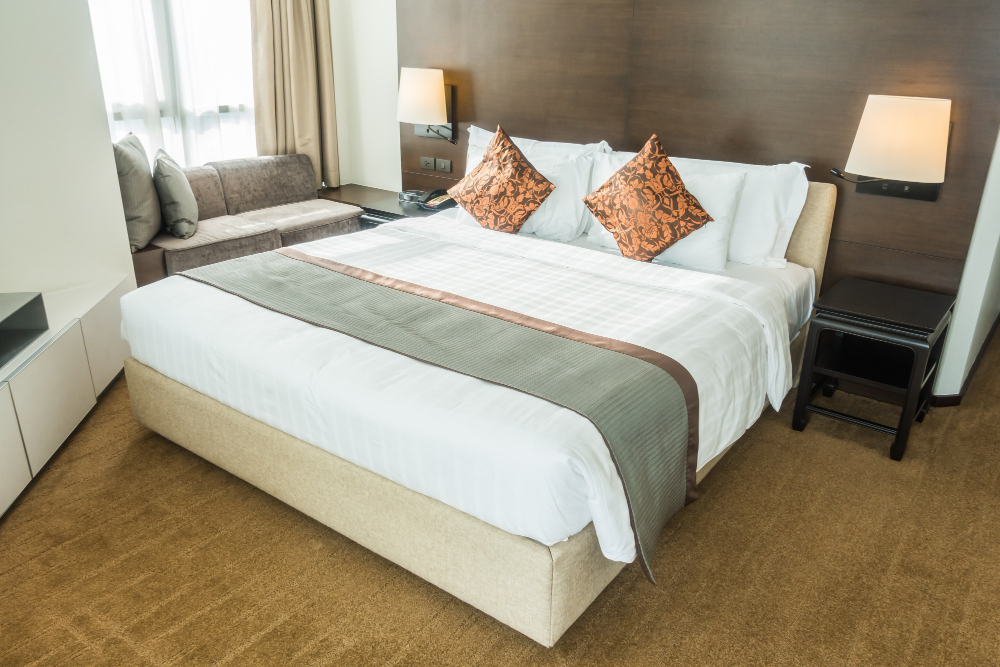
Repairing your bed is almost always the smarter choice in Dubai, typically costing 50% to 70% less than buying new, unless the frame is structurally broken or the bed is already on its second or third repair. This decision matters because a bed is one of the most expensive furniture pieces in a Dubai home, and getting the call wrong means either wasting money on a doomed repair or throwing out a frame that had years of life left in it. In this guide, we walk through the exact signs that separate a fixable bed from one that’s finished, what repairs actually cost in Dubai, how the local climate accelerates wear, and when replacement genuinely makes more sense than repair.
What determines whether a bed should be repaired or replaced?
The decision comes down to three factors: the condition of the structural frame, the age and repair history of the bed, and the cost of repair relative to the cost of an equivalent replacement. If the frame itself is intact, almost everything else (joints, slats, headboard upholstery, fabric, foam) can be repaired.
These three factors don’t carry equal weight. Frame condition matters most because a cracked or warped frame undermines every other repair. Repair history matters second, since a bed that has already failed once in the same spot is more likely to fail again nearby. Cost comparison matters last, because it only becomes relevant once the first two checks confirm the bed is structurally worth saving.
A frame made from solid wood or welded metal can usually be repaired dozens of times over its lifespan. A frame made from particleboard or chipboard, common in flat-pack and budget beds, loses its ability to hold screws after two or three tightenings. At that point, replacement is the only real fix.
We’ve seen this play out consistently across Dubai households: solid-frame beds from villas in Jumeirah or Arabian Ranches often come in for their third or fourth repair after eight-plus years, while particleboard beds from short-term rental apartments are frequently unrepairable by year three.
Common bed problems in Dubai homes
The most frequent bed issues we see in Dubai are loose or stripped joints, sagging or broken slats, torn or sun-faded headboard fabric, squeaking frames, and cracked wood at connection points. These problems cluster around specific causes tied to local living conditions.
Loose joints are almost always caused by repeated humidity swings rather than simple age. Squeaking usually points to worn screw holes rather than a structural fault. Faded or brittle headboard fabric is a near-universal issue in west-facing bedrooms that get direct afternoon sun through the window.
Dubai apartments run air conditioning nearly year-round, which keeps indoor humidity low and wood dry, while outdoor humidity during summer months regularly exceeds 80%. This constant cycling between dry indoor air and humid transitional periods, such as moving furniture or open balcony doors during power cuts, causes wood to expand and contract more than it would in a climate-stable environment. Over several years, this repeated movement is what strips screw threads and loosens mortise-and-tenon joints, even in well-built frames.
A joint that has loosened once and been re-tightened will loosen again faster the second time, since the screw hole has already been enlarged. This is why we recommend reinforcing loose joints with dowels or larger screws rather than simply re-tightening the original fixing. It’s the difference between a repair that lasts one year and one that lasts five.
Signs your bed needs repair vs replacement
A bed needs repair when the problem is localized, such as a single loose joint, one broken slat, worn fabric, or a squeaking frame, and the surrounding wood or metal is still solid. A bed needs replacement when the damage is structural, widespread, or has already recurred after a previous repair in the same area.
Here is the practical breakdown we use when assessing a bed on-site:
Repair it if:
- One or two slats are broken but the rest are intact
- Joints are loose but the wood around the screw holes hasn’t crumbled
- The headboard fabric is torn, stained, or faded but the frame underneath is solid
- The bed squeaks but doesn’t wobble or shift under weight
- This is the first repair the bed has needed
Replace it if:
- The main frame rail is cracked or split along the grain
- Screw holes have stripped so badly that screws no longer bite into the wood
- The bed has been repaired at the same joint two or more times
- Metal frame welds have failed or the metal itself has visibly rusted through
- The bed visibly wobbles or shifts even when fully assembled and tightened
Once a frame shows two or more of the replacement signs together, repair costs typically climb close to replacement cost anyway, which is when a professional assessment becomes worth requesting before spending on parts and labor.
Cost of bed repair in Dubai vs cost of a new bed
Bed repairs in Dubai generally range from AED 150 for a simple joint tightening or slat replacement to AED 800–1,200 for a full frame reinforcement and headboard reupholstery. A comparable new bed frame with headboard, by contrast, typically starts around AED 1,500 for budget models and runs AED 3,000–8,000 or more for mid-range and premium furniture.
| Issue | Typical Repair Cost (AED) | Typical Replacement Cost (AED) |
|---|---|---|
| Loose or stripped joints (reinforced) | 150 – 350 | 1,500+ (full bed) |
| Broken slats (replaced) | 100 – 250 | 1,500+ (full bed) |
| Headboard reupholstery | 400 – 900 | 800 – 3,000 (headboard only) |
| Full frame reinforcement + reupholstery | 800 – 1,200 | 3,000 – 8,000+ |
| Antique/custom bed restoration | 1,000 – 3,000 | Often not replaceable at any price |
These figures reflect general Dubai market ranges and vary based on materials, fabric grade, and the complexity of the repair. As the table shows, even the most extensive repair, full frame reinforcement combined with reupholstery, still lands well below the cost of a mid-range replacement bed, which is why repair remains the default recommendation unless the frame itself has failed structurally.
How long do repaired beds last?
A properly repaired bed frame typically lasts another 5 to 8 years before needing attention again, assuming the original wood or metal structure was sound. This is close to the lifespan of a new mid-range bed, which makes repair a genuinely comparable alternative rather than a temporary patch.
The longevity of a repair depends heavily on technique. A joint reinforced with dowels, wood glue, and appropriately sized screws will outlast one that’s simply re-screwed into the original hole. Reupholstered headboards using UV-resistant or moisture-resistant fabric also tend to hold up longer in Dubai’s sun exposure and humidity swings than the original factory fabric.
We generally see solid hardwood frames go through two or three repair cycles over 15–20 years before replacement becomes necessary, while particleboard frames rarely make it past a single repair cycle before the material itself gives out.
This gap between hardwood and particleboard longevity connects directly to the type of repair a bed needs. The material dictates not just how long a fix lasts, but which repair techniques are even possible in the first place.
Types of bed repairs we handle in Dubai
Bed repairs generally fall into five categories: frame and joint repair, slat replacement, headboard reupholstery, hardware replacement, and finish restoration. Each addresses a different point of failure.
Frame and joint repair involves reinforcing or rebuilding the connections between the head, foot, and side rails. It is usually the most structurally important repair a bed can receive. Slat replacement swaps out broken or sagging support slats, which is typically the fastest and least expensive fix. Headboard reupholstery replaces worn, torn, or faded fabric and foam padding on upholstered headboards, restoring both appearance and comfort. Hardware replacement covers bolts, brackets, and center support legs that wear out from repeated assembly or heavy use. Finish restoration addresses scratched, sun-bleached, or water-damaged wood surfaces on solid wood frames.
Of these, frame and joint repair and headboard reupholstery are by far the most requested services in Dubai, largely because of how the climate and sun exposure specifically target those two components. If you’d like to see fabric and finish options before deciding, our bed upholstery services page walks through the styles and materials we work with most often.
Bed frame repair vs replacement
A wooden or metal bed frame should be repaired rather than replaced whenever the core rails and corner joints remain intact, even if individual connectors have failed. Frame replacement only makes sense when the rails themselves are cracked, warped, or made from a material such as particleboard that can no longer hold fasteners.
Solid wood frames respond well to repair because damage is usually localized to the joints rather than the wood itself. A carpenter can drill out a stripped screw hole, insert a wood plug, and re-drill a fresh hole that holds as securely as the original. It’s a technique that can be repeated multiple times over a frame’s life. Metal frames respond similarly well, since a failed weld or bent bracket can typically be re-welded or replaced without touching the rest of the structure.
Particleboard and MDF frames are the exception. Because these materials compress and crumble around screw holes rather than holding a clean thread, they generally can’t be effectively repaired more than once. The material itself, not the design, is the limiting factor.
Upholstered headboard repair vs replacement
An upholstered headboard is almost always worth repairing rather than replacing, since the wooden frame underneath the fabric typically outlasts several rounds of fabric and foam. Reupholstering a headboard costs a fraction of buying a new one and lets you change the fabric, color, or texture entirely if you want an updated look.
The reupholstery process involves stripping the old fabric and foam down to the wood frame, checking the frame for damage, replacing the foam padding if it has compressed or yellowed, and fitting new fabric with fresh stapling or stitching. Foam typically needs replacing every 5–7 years even if the fabric itself still looks fine, since foam degrades from body oils, humidity, and UV exposure faster than fabric does.
Only when the wooden frame behind the upholstery has cracked, warped, or rotted from water damage does headboard replacement become the better option over reupholstery. For homeowners who want to change the look entirely rather than just restore it, our piece on custom sofa bed upholstery covers how far you can push a redesign during a reupholstery job.
Is it worth repairing an antique or custom bed?
Antique and custom-made beds are almost always worth restoring rather than replacing, since they’re typically built from solid hardwood that modern mass-produced frames rarely match, and they often carry sentimental or resale value that a new bed cannot replicate. Restoration costs more than a standard repair but remains far below the cost, or in many cases the impossibility, of sourcing an equivalent replacement.
Antique frames were generally built using joinery techniques like mortise-and-tenon or dovetail joints designed to be disassembled and repaired rather than replaced outright. This makes them more restorable, not less, compared to modern beds held together with cam locks and particleboard dowels.
Custom-made beds, built to a specific size, wood species, or design, face a different problem: replacement isn’t just costlier, it’s often not possible to match exactly. Restoration is frequently the only way to preserve the original design intent.
How Dubai’s climate affects bed longevity
Dubai’s climate shortens bed lifespan primarily through two mechanisms: humidity-driven wood movement and UV-driven fabric degradation. Summer humidity above 80% combined with near-constant air conditioning creates repeated expansion and contraction cycles in wood, while intense year-round sun exposure breaks down upholstery fabric and foam faster than in temperate climates.
Wood movement from humidity cycling is the leading cause of loosened joints in Dubai homes, more so than simple mechanical wear from use. Furniture placed near windows or balcony doors, where indoor AC air meets outdoor humidity most directly, tends to show joint problems earlier than furniture in more climate-stable interior rooms.
UV exposure through windows, even with tinted glass, breaks down dyes in upholstery fabric and dries out foam padding, causing it to crumble or lose its supportive shape years before it would in a lower-sun climate. This is why headboard fabric in Dubai bedrooms often fades or weakens well before the underlying frame shows any wear at all.
Because these two climate effects target different components, joints versus fabric, a bed in Dubai often needs frame reinforcement and headboard reupholstery on different timelines, even though both problems trace back to the same underlying climate conditions.
DIY bed repair vs professional bed repair
Simple fixes like tightening loose screws or replacing a single slat are reasonable to attempt yourself. Structural repairs, including joint reinforcement, frame cracks, reupholstery, or anything involving antique or high-value furniture, are best left to a professional, since a poorly executed structural repair often fails faster than the original problem and can make the frame harder to repair correctly afterward.
The main risk with DIY structural repairs is over-drilling or misaligning a screw hole, which can permanently weaken that section of the frame and eliminate the option of a clean professional repair later. Reupholstery mistakes are less permanent but still costly, since removing and redoing a poor fabric job wastes both the original fabric and the labor.
Our furniture repair team follows a simple rule when giving this advice: if the repair involves only a screwdriver and a spare part you can buy off the shelf, DIY is fine. If it involves glue, drilling new holes, welding, or fabric work, a professional assessment is worth the cost, particularly because we can often confirm within minutes on-site whether a bed is a repair or replacement case, saving you from spending on parts for a frame that was never going to hold.
Is it cheaper to repair or replace a bed in Dubai?
The short answer
Yes, repair is cheaper than replacement in the vast majority of cases, typically saving 50% to 70% of the cost of an equivalent new bed, as long as the frame itself is structurally sound.
When replacement is the better financial choice
Replacement makes more sense when the frame is built from particleboard and has already failed once, when the same joint has needed repair two or more times, when the main rails are cracked along the grain, or when repair costs approach 70% or more of a comparable new bed’s price. In these cases, spending on repair often just delays an inevitable replacement while adding to the total cost.
When repair is the better financial choice
Repair is the better choice whenever the frame is solid wood or metal, the damage is localized to one or two components, and this is the bed’s first or second repair. It’s also the better choice for antique, custom, or high-value beds where replacement isn’t a true equivalent option regardless of price.
The verdict
For most Dubai households, repair is both the cheaper and more practical option. The exceptions are narrow and specific: particleboard frames, beds already repaired multiple times at the same point, and frames with cracked structural rails. Outside of those cases, a professional repair extends the bed’s life by another 5 to 8 years at a fraction of replacement cost.
FAQs Related to Bed Repair vs Replacement in Dubai
Is it cheaper to repair or replace a bed in Dubai?
In most cases, repairing a bed in Dubai costs 50% to 70% less than buying a new one, especially for frame, joint, and upholstery issues. Replacement only becomes more cost-effective when the frame is structurally compromised or the bed has already been repaired multiple times.
How long does a repaired bed last in Dubai?
A professionally repaired bed frame or headboard typically lasts another 5 to 8 years in Dubai homes, provided the underlying wood or metal structure is sound and humidity control is reasonable.
Does Dubai’s climate affect bed lifespan?
Yes. High humidity from May to September, combined with constant air conditioning, causes wood joints to expand and contract repeatedly, which loosens screws and fittings faster than in drier, more stable climates.
Can an antique or custom bed be repaired instead of replaced?
Most antique and custom-made beds can be restored rather than replaced, since their frames are often built from solid hardwood that outlasts mass-produced modern furniture. Restoration also preserves value that a replacement cannot.
Get a Free Bed Assessment in Dubai
If you’re unsure whether your bed is worth repairing, the team at Repair Sofa Dubai can usually tell you within minutes of seeing it. Our team assesses frames, joints, and upholstery on-site across Dubai and gives you an honest recommendation, repair or replace, along with a clear cost estimate before any work begins. Reach out to us for a free quote and we’ll help you make the right call for your bed and your budget.
