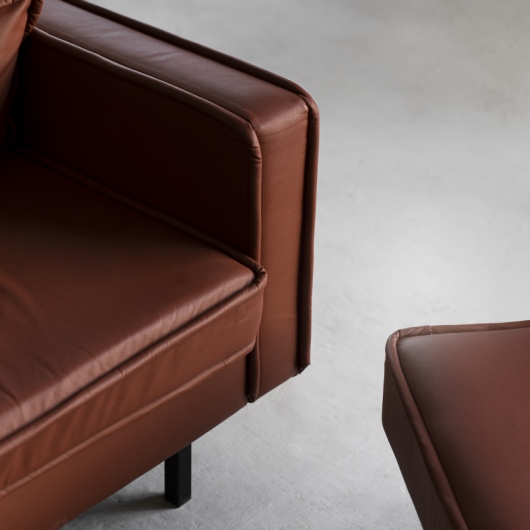
Leather resists dust, wipes clean instantly, and can last 15 to 25 years with proper care, which makes it a strong choice for Dubai homes, as long as the room has consistent, stable air conditioning. The real decision isn’t just fabric versus leather, it’s which leather grade actually fits your budget and how your specific room is cooled.
This guide focuses on the two things that actually determine whether leather is the right call: which grade you’re paying for, and whether your room’s conditions suit it. For the broader material comparison against fabric, our leather vs fabric sofa guide covers durability, comfort, and cost side by side in more depth.
What leather grade should you actually choose?
Leather sold for upholstery falls into four main grades, full-grain, top-grain, corrected-grain, and bonded or faux leather, and the grade matters more than almost any other factor in how the sofa performs and ages over time.
Full-grain leather
Full-grain uses the entire natural hide with none of the surface sanded away, which means it shows the leather’s natural markings and develops a rich patina as it ages. It’s the most durable and highest-cost option, typically lasting 20 to 25 years or more with proper conditioning.
Top-grain leather
Top-grain has the very top layer lightly sanded and treated, giving it a more uniform, consistent appearance while still using genuine leather. It costs less than full-grain and holds up well, typically lasting 15 to 20 years, making it a strong middle-ground choice for most households.
Corrected-grain leather
Corrected-grain leather has more of the surface sanded and an artificial texture embossed on top, which lowers cost further but also reduces breathability and long-term durability compared to full or top-grain. It’s a reasonable option for lighter-use furniture on a tighter budget.
Bonded and faux leather
Bonded leather uses scraps of leather fiber bonded together with a polyurethane coating, while faux leather is entirely synthetic. Both cost significantly less upfront but typically only last 3 to 7 years before peeling or cracking, especially under Dubai’s heat and sun exposure.
The grade you choose should match how the piece will actually be used. A daily-use family sofa justifies the investment in top-grain or full-grain, while a rarely used accent chair may not need to carry that same cost.
Does leather suit Dubai’s climate specifically?
Leather performs well in Dubai only when the room’s air conditioning runs consistently. Temperature cycling, switching AC on and off throughout the day, is one of the leading causes of leather cracking here, more than heat or humidity on their own.
This is worth checking honestly before committing to leather. A room where AC runs consistently between 20 and 24°C year-round gives leather a stable environment to hold up in. A room where the AC gets switched off during the day, common in guest rooms or homes where residents are away for long stretches, puts leather at a real disadvantage compared to fabric, which doesn’t have the same sensitivity to these swings.
Is leather a good investment compared to fabric?
Leather generally offers better long-term value in rooms with stable climate control, since its longer lifespan can offset the higher upfront cost over time. In less climate-stable spaces, that advantage narrows or disappears, since leather that cracks prematurely no longer delivers on its durability promise.
Think of the investment case as conditional rather than universal. Full-grain leather in a consistently cooled living room genuinely outlasts most fabric options and can justify its higher price. The same leather in an inconsistently cooled space may need reupholstery sooner than a well-chosen fabric would have, which flips the value equation entirely.
Which rooms and households suit leather best?
Leather suits formal living rooms, home offices, and daily-use family rooms with consistent AC particularly well, since it holds up to regular use and wipes clean quickly. It’s also a strong fit for households that prioritize low-maintenance cleaning over the softer feel of fabric.
Households with young children who eat on the sofa often, or homes with pets prone to scratching, tend to benefit from leather’s wipe-clean surface and scratch resistance more than a typical formal setting would. If personalization matters to you as much as performance, our guide on custom leather upholstery covers color, stitching, and finish options in more detail.
What to check before committing to leather
Before choosing leather, check your room’s AC consistency, how much direct sun exposure the piece will get, and your realistic budget for the grade that matches your household’s usage. These three checks catch most of the situations where leather underperforms expectations.
Direct sun exposure specifically can dry out even well-maintained leather faster than expected, so a piece positioned near an unshaded window may need more frequent conditioning regardless of grade. If in doubt, ask for a leather sample to test near your specific window or AC vent before committing to a full order.
Is higher-grade leather always worth the extra cost?
The short answer
No. Higher-grade leather is worth it for daily-use furniture in climate-stable rooms, but a lower grade can be perfectly reasonable for occasional-use pieces or tighter budgets.
When is a higher grade worth it
Full-grain or top-grain leather pays off on daily-use sofas in consistently cooled rooms, where the extended lifespan offsets the higher upfront cost within a few years.
When a lower grade is fine
Corrected-grain or even quality faux leather can be a reasonable choice for accent chairs, guest rooms, or budget-conscious projects where the piece sees lighter use.
The verdict
Match the grade to the piece’s actual role in your home rather than defaulting to the highest grade available. A well-matched mid-grade leather often outperforms an expensive full-grain hide placed in the wrong conditions.
Frequently Asked Questions
Why is leather a good choice for a Dubai home?
Leather resists dust, wipes clean instantly, and can last 15 to 25 years with proper care, making it well suited to Dubai homes as long as the room has consistent, stable air conditioning to prevent drying and cracking.
What leather grade is best for a sofa?
Full-grain leather offers the highest quality and develops character over time, top-grain offers strong durability with more uniform appearance at a lower cost, and corrected-grain or bonded leather suit tighter budgets but wear faster.
Is leather always worth the higher cost compared to fabric?
Not always. Leather is worth the investment in rooms with stable air conditioning and for households prioritizing easy maintenance, but fabric can be the more practical and cost-effective choice in less climate-controlled spaces.
Find the Right Leather for Your Home
Our team can bring leather samples in every grade to your home, check how your specific room’s conditions affect the decision, and help you choose the right leather for your budget and lifestyle. Visit our leather sofa upholstery services page to see our full range, or reach out for a free consultation and quote.
